Don’t Buy a Dining Table Before Reading This (Big Mistakes Indian Homes Make)
You won’t believe how many beautiful Indian homes feel uncomfortable — all because of one furniture decision.
A family spends weeks choosing a stylish dining table. It looks perfect in the showroom. Premium finish. Solid material. Great price. They bring it home…
…and suddenly the house feels tight. Walking around becomes annoying. Chairs keep hitting walls. Someone always has to “adjust.” Meals feel less relaxing than before.
We see this all the time.
At Dimensional Architects, this is one of the most common interior mistakes we correct during home transformation projects. The issue is not the table design. It’s lack of space planning — something most Indian homes skip.
Let’s talk honestly, like we do with our clients.
The Real Problem Isn’t the Table — It’s Planning
Most people buy a dining table based on:
- How it looks
- How many people in the family
- What fits in the showroom
But homes are not showrooms.
Showrooms have wide walking areas, high ceilings, and open layouts. Your home has walls, passages, doors, and daily movement. That difference changes everything.
In modern home interiors, furniture must work with life, not just with style. That’s the difference between a house that looks good and a home that feels good.
Why This Happens in Most Indian Homes
Let’s be real.
Indian homes are active spaces. Parents moving in and out of the kitchen. Kids running. Guests visiting. Storage units nearby. Sometimes the dining area is part of the living room.
But when buying furniture, people imagine only the moment of sitting and eating — not the 20 other daily activities around that space.
At Dimensional Architects, we often hear:
“The table is nice, but the area feels cramped now.”
That one sentence says everything.
The Simple Dining Table Size Guide Nobody Tells You
Here’s where most interior mistakes happen.
People measure only the table size. But the real rule is:
Dining table + movement space = correct size
You need at least 3 feet (90 cm) of open space around the table for comfortable movement. That’s not luxury — that’s basic usability.
So if your dining area is 10 feet wide:
- Table should NOT be 6 feet wide
- Because chairs + people + walking space will block everything
In luxury interior design, we plan for how people move, not just how furniture sits. That’s why high-end homes always feel spacious even with large furniture.
Space is not about house size.
Space is about smart planning.
Why Homes Feel Crowded After Buying Furniture
Because furniture is added emotionally, not logically.
You see a beautiful 8-seater table and think, “Guests will come, we need space.” But guests come occasionally. Your daily life happens every single day.
When space planning is ignored, the home slowly becomes stressful. Small irritation. Less comfort. Less ease.
A home should reduce stress, not create it.
This is exactly where Dimensional Architects focus during modern home interiors projects — we plan for daily life first, occasions later.
Material Choices: Looks vs Lifestyle
People choose dining tables based on appearance. But materials affect comfort more than you think.
Wood – Warm, durable, timeless. Best for daily family use.
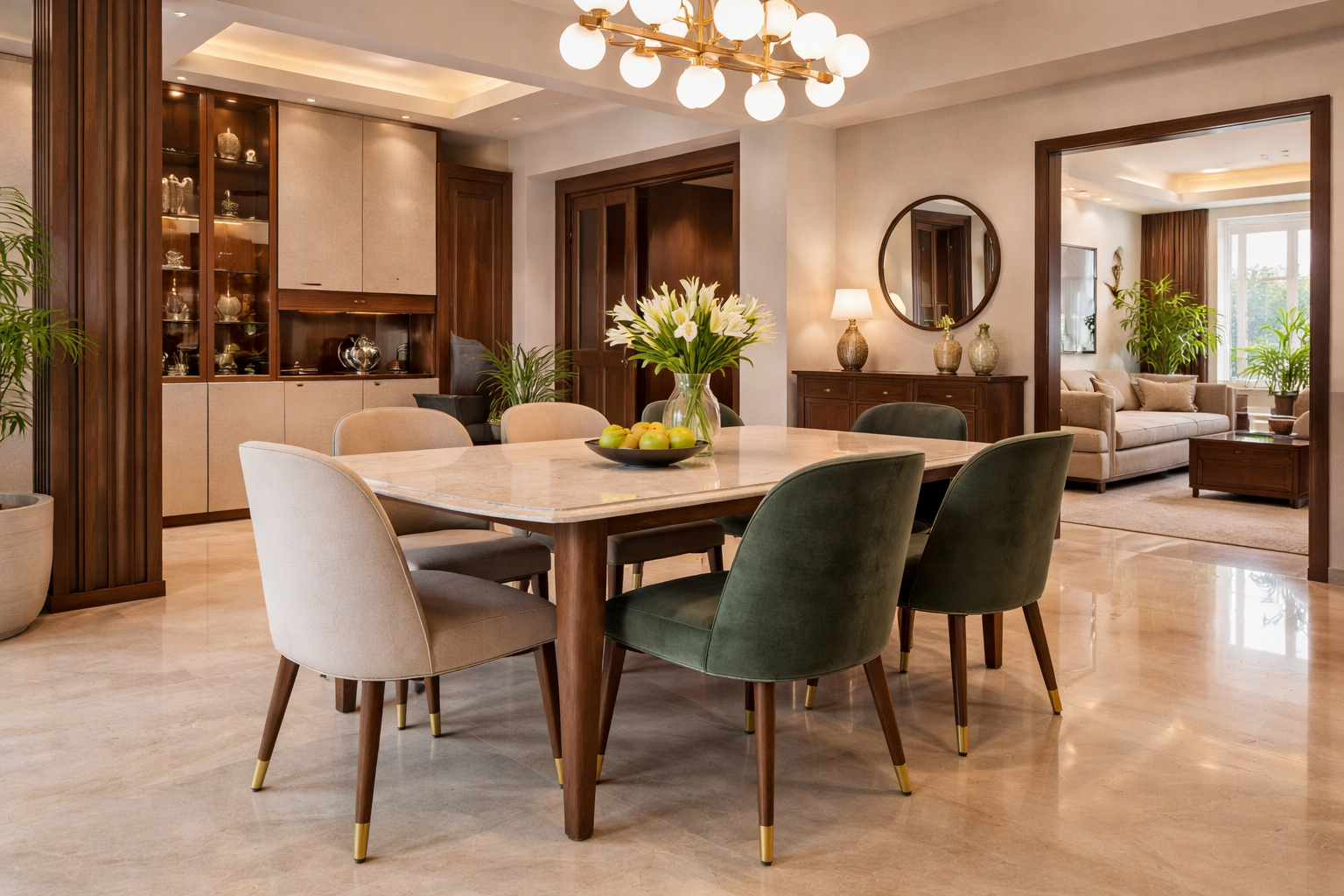
Marble – Luxurious look, but heavy and cold. Needs bigger spaces.
Glass – Modern, but shows marks and fingerprints. Not kid-friendly.
Laminate – Practical and budget-friendly, but less premium feel.
In luxury interior design, materials are selected based on how a family lives. Not what’s trending.
A table that worries you every day is not a good table.
Why Dining Chairs Matter More Than the Table
Most people spend hours choosing the table… and 10 minutes choosing chairs.
Big mistake.
Chairs decide:
- Comfort during meals
- Back support
- How long people sit together
- How relaxed the space feels
Uncomfortable chairs make even a luxury table useless.
At Dimensional Architects, we always tell homeowners:
A dining space is experienced through the chair, not the table.
The Hidden Problem: Table Leg Design
This sounds small, but it changes daily life.
Thick corner legs = knees hitting wood
Center pedestal = better leg movement
Wide frames = less space for chairs
Poor leg design makes people sit awkwardly. Kids avoid the table. Guests adjust constantly.
Good design is not visible. But you feel it.
That’s the thinking behind luxury interior design — comfort you don’t notice, but miss when it’s gone.
Real Planning Insight from Dimensional Architects (BKC, Mumbai)
In one of our projects near BKC, Mumbai, a family had a beautiful marble dining table. Expensive. Stylish. But the room always felt tight.
We didn’t change the room size.
We didn’t break walls.
We simply resized the table, changed the leg design, improved chair proportions, and reworked surrounding furniture placement.
Result?
The same home suddenly felt bigger. Easier. More breathable.
That’s the power of space planning.
Small design change. Big emotional relief.
Before vs After Thinking
Before planning
“I like this table. Let’s buy it.”
After smart interior design tips
“How will we move around it daily?”
That one shift changes everything.
This is why professional guidance matters. Not to make things expensive — but to prevent costly interior mistakes that affect your comfort for years.
Your Dining Space Is About Feelings, Not Furniture
Dining areas are where families talk, laugh, sit together after long days.
If the space feels tight, uncomfortable, or blocked — people leave faster. The emotional value reduces.
Good planning supports connection.
Bad planning creates silent frustration.
That’s the real difference between basic homes and modern home interiors done right.
Final Thought
A dining table is not just a product. It’s part of your everyday life.
Measure your space. Think about movement. Think about comfort. Think about daily living.
Or better — plan first, buy later.
Because once furniture enters the house, fixing mistakes becomes expensive.
And your home deserves comfort, not compromise.